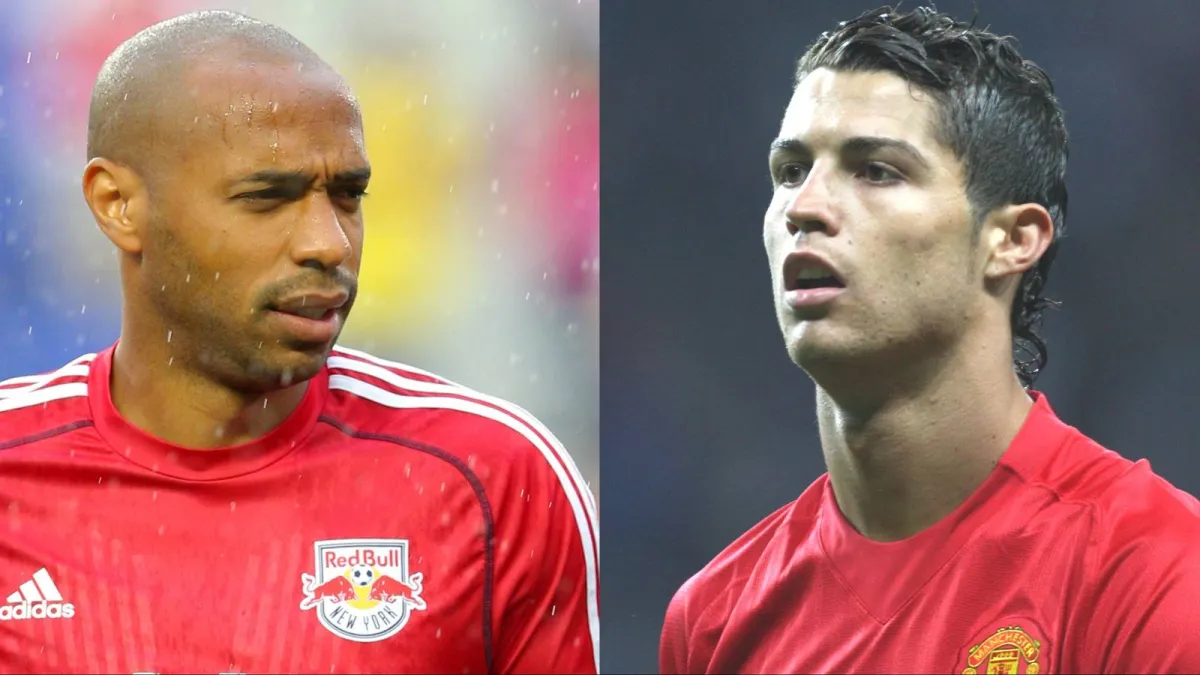
The idea of Cristiano Ronaldo and Thierry Henry sharing a dressing room was once so compelling it bordered on inevitability. Both men are widely regarded as the two most dominant forces the Premier League has ever seen—Ronaldo’s physicality and finishing for Manchester United, Henry’s vision and creativity for Arsenal—yet their paths never crossed. The closest they came was a near-miss that would have rewritten the history of English football.
The premise was simple: imagine Henry’s technical mastery paired with Ronaldo’s goal-scoring instinct, both operating under the same manager, in the same system. The numbers alone suggest what could have been. Henry’s 228 Premier League goals and 100 assists stand as a testament to his ability to dictate games, while Ronaldo’s 184 goals and 63 assists in the league prove his capacity to finish with ruthless efficiency. Together, they would have been a force so potent it might have forced the league’s defenses to evolve entirely. Yet, the transfer windows and club loyalties that defined their eras ensured this partnership remained just out of reach.
The tactical implications of such a duo would have been fascinating. Henry’s preference for feeding strikers like Robin van Persie or Emmanuel Adebayor—players who thrived on movement and positioning—would have clashed with Ronaldo’s more direct, counter-attacking style, which relied on pace and space. Former France striker Thierry Henry himself has since reflected on how Ronaldo’s approach has shifted over time, noting that the striker’s modern game demands more support from teammates. ‘If you play with Cristiano Ronaldo, the other guys need to do a tiny bit more in terms of running in behind,’ Henry said in recent analysis. ‘He’s not going to run into the channel. You need to feed him in the box.’ This dynamic would have been a fascinating study in adaptation, with Henry’s Arsenal system—built on possession and quick transitions—potentially clashing with Ronaldo’s need for space and decisive moments.
The irony is that their careers overlapped in ways that made the idea feel almost fated. Both men were at their peak in the mid-2000s, when the Premier League was the ultimate proving ground for global talent. Ronaldo’s move to Real Madrid in 2009 and Henry’s departure from Arsenal in 2012 left no realistic window for a transfer. But the hypothetical remains tantalizing: how would their rivalry have played out on the pitch? Would Henry’s ability to dictate tempo have tempered Ronaldo’s occasional self-isolation? Or would their individual brilliance have overwhelmed even the most disciplined defenses? The answer may never be known, but the legacy of what could have been lingers—especially now, as both men face fresh challenges in their respective World Cup campaigns.
For now, the closest they’ve come to sharing a stage was in the 2026 World Cup group stage, where their tactical philosophies clashed in ways that exposed Portugal’s vulnerabilities. In a match where Ronaldo’s individual moments were overshadowed by Portugal’s collective struggles, pundits like Henry and Zlatan Ibrahimović pointed to a fundamental issue: Ronaldo’s reliance on being fed into dangerous positions rather than creating them himself. ‘He wants to score, he goes into the path of the pass,’ Henry observed. ‘That’s my thing—the team needs to score, not you.’ The words carry weight, not just as criticism but as a reminder of how far Ronaldo’s game has evolved—and how much his teammates must now adjust to keep pace with him. Whether that adjustment happens in time for Portugal’s remaining fixtures remains the question.