
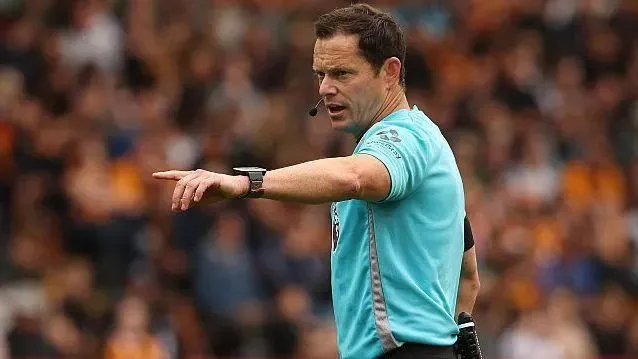
Darren England’s 100th Premier League game was met with the kind of applause usually reserved for players who’ve just won trophies. The plaudits weren’t just for his 20 years of service—though that alone would have earned him respect—but for the way he’d turned a career-defining blunder into a story of redemption. Three years earlier, a VAR error in a Tottenham vs. Liverpool clash had stalled his progression, leaving him questioning whether the game’s most scrutinized role was even for him. Yet here he was, standing tall in the spotlight, a role model for referees navigating an era where every decision is dissected under a microscope.
The modern referee’s kit is nothing like the one England carried when he first stepped onto the Premier League stage. Today’s officials are ‘dressed like RoboCop,’ as England himself put it, burdened with communication devices, video feeds, and a mountain of tactical responsibilities that didn’t exist a decade ago. The pressure is relentless: one misstep—like the VAR call that saw him flagged for a penalty in a high-stakes Liverpool game—can become a career-defining moment. England’s career nearly became a cautionary tale, but instead, it became proof that football’s most unglamorous heroes can turn setbacks into comebacks. His recent milestone wasn’t just about numbers; it was about proving that even in a system where perfection is impossible, consistency and character matter more.
The moment England was called forward to receive his 100th-game plaque, it was clear this wasn’t just a personal achievement. Hugh Dallas, director of the Professional Referee Group, singled him out as a ‘role model’—a rare public acknowledgment in a profession where criticism often drowns out praise. That recognition carries weight in a game where referees are both revered and reviled in equal measure. England’s journey mirrors the broader evolution of refereeing in the Premier League, where the role has expanded from pure authority to a high-stakes blend of technology, psychology, and tactical awareness. His ability to weather the storm of public scrutiny—especially after the VAR controversy—shows how resilience isn’t just a trait; it’s a requirement.
What makes England’s story particularly compelling is how it intersects with the broader conversation about football’s culture. The VAR error that nearly derailed him wasn’t just a technical failure; it was a symptom of a system where every official is held to an impossible standard. Yet, by focusing on the fundamentals—preparation, adaptability, and mental fortitude—England turned criticism into credibility. His path from assistant referee to top-flight authority isn’t just a personal triumph; it’s a testament to how football’s most underrated professionals continue to redefine their role in an ever-changing game.
As England looks ahead to the FA Cup final and the Champions League, his career serves as a reminder that in football, as in life, the ability to bounce back isn’t just about talent—it’s about how you handle the moments that test you. For a profession where one bad call can overshadow a lifetime of service, his journey offers a rare glimmer of hope: that even in the most scrutinized roles, character ultimately prevails.