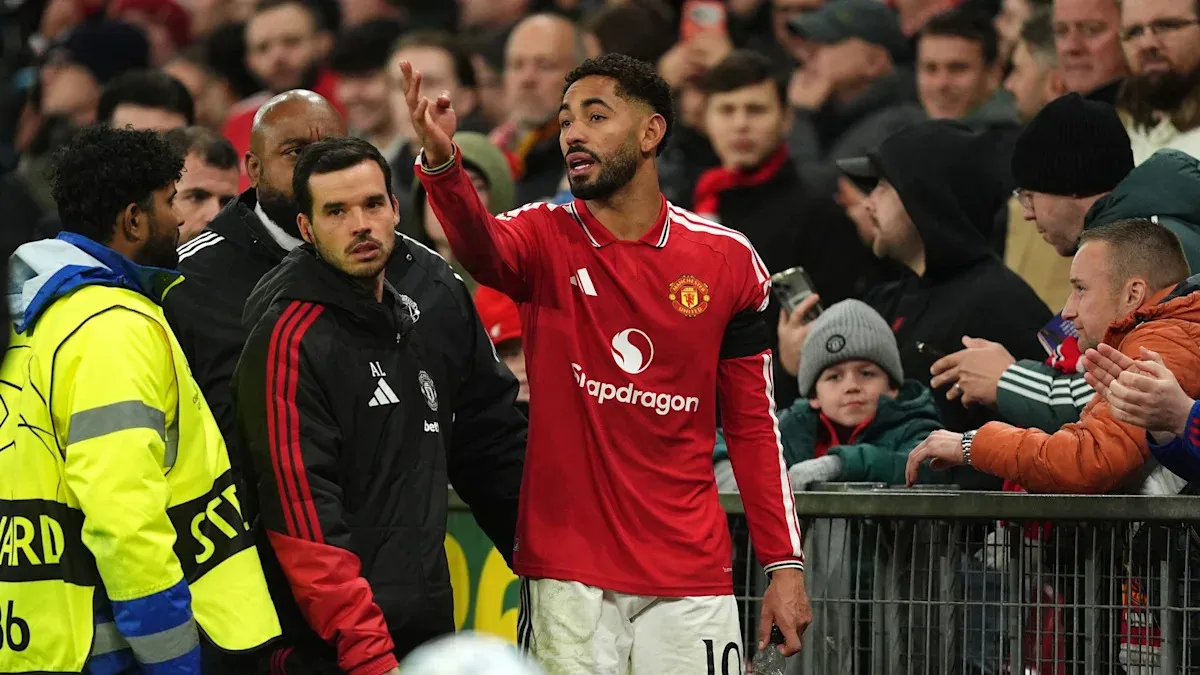
Manchester United’s Champions League campaign took another dramatic turn when Matheus Cunha became the first player in the competition’s history to win a penalty, score a goal, and be sent off in the same match. His late red card against Roma on Tuesday—earned for a second yellow after a poor challenge—should have triggered a two-match ban under UEFA’s regulations. Yet the Brazilian’s failure to leave the field immediately after the dismissal, instead lingering near his teammates before the final whistle, has now been ruled a non-issue by the governing body.
UEFA’s decision to impose only the standard one-match suspension for Cunha’s second yellow—rather than extending it for his breach of protocol—marks a rare reprieve in a case that could have set a precedent. A spokesperson confirmed that the incident was not flagged in the official reports, meaning no further investigation was warranted. This outcome ensures Cunha remains available for United’s upcoming trip to Sporting Lisbon, where he’ll look to rebuild momentum after a chaotic final 15 minutes against Roma. The ruling also underscores the fine line between tactical defiance and disciplinary oversight, particularly in matches where players are already operating under immense pressure.
Cunha’s performance against Roma was a microcosm of United’s resurgent energy. His penalty conversion—secured by Bruno Fernandes at the second attempt—turned a 2-1 deficit into a 3-2 victory, a result that restored some faith in the Red Devils’ Champions League credentials after a shaky start. Yet the same match that delivered a crucial win also exposed the vulnerabilities of a squad still finding its rhythm. Michael Carrick’s intervention to guide Cunha toward the tunnel was a rare moment of clarity amid the chaos, but it came too late to prevent the Brazilian’s eventual dismissal. The incident serves as a reminder that even the most explosive talents can be undone by small errors in high-stakes moments.
For Cunha, the Sporting Lisbon game will be an opportunity to prove his worth beyond the dramatic. His ability to adapt to the physical demands of the Champions League—where Roma’s pressing and tactical discipline tested United’s depth—will be critical. The Brazilian’s versatility, whether as a winger or false nine, has been a cornerstone of Carrick’s tactical experiments, but consistency in discipline will now be just as important. With Porto’s resurgence and Napoli’s resilience threatening United’s group ambitions, every player’s focus must align. Cunha’s return, without additional punishment, clears the way for him to contribute to a team that needs all its firepower if it’s to avoid early elimination.
The ruling also raises broader questions about UEFA’s enforcement of disciplinary protocols. While the governing body’s decision here was pragmatic, it may leave room for interpretation in future cases. Players and coaches will now scrutinize whether lingering on the pitch after a red card—particularly in stoppage time—could still carry unintended consequences. For now, Cunha’s Champions League redemption story remains intact, but the lesson is clear: in football’s most prestigious competition, even the most spectacular performances can be overshadowed by moments of carelessness.